

Just a breath
Taking a breath when we're triggered is simple, effective and incredibly hard to do!

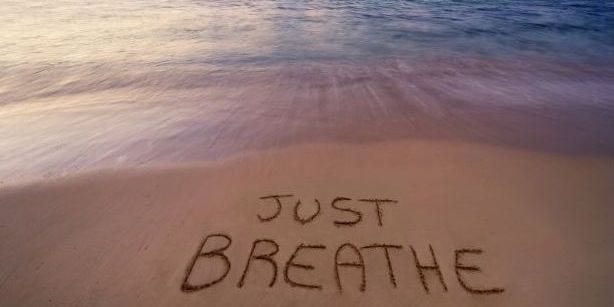
I often work with parents who are finding life challenging. They may be supporting children who are recovering from a stressful school experience, have limited support and understanding from those around them or feeling overwhelmed at the idea that they are now in sole charge of their child’s education. Whatever the situation, emotions are often running high and nervous systems are feeling frazzled by the relentless triggers of daily life.
Our whole deschooling journey requires us to be constantly looking at “what is” and getting curious about our reactions and responses. In fact, we might say that our deschooling happens precisely in the triggered moments. This is where we choose to either follow our old reactions and stories or figure out if there is a more coherent response that feels more aligned with who we are and what we want for our children.
When I talk about taking a breath when we are in the grab of a trigger, I am aware that it often sounds like a tiny solution to a big problem, particularly for those parents whose lives feel particularly challenging. It sounds unrealistic that taking a breath in such a difficult moment of conflict, anxiety or dysregulation could have any effect. A breath? If only it were that easy!
But here’s the thing. Taking a breath is not easy. When we’re triggered (and it could be by a real situation or by something we’re just thinking about), our nervous system goes into fight, flight, or freeze, and stress hormones start flooding the system. The part of the brain that handles clear thinking and decision-making (the prefrontal cortex) goes offline, whilst the part that deals with emotions (the amygdala) takes over. Our minds may feel under attack by lots of chaotic thoughts, and our bodies feel tense and uncomfortable. In this state, everything feels urgent and reactive, and (because survival will always be our top priority) we’re wired to speed up and take action.
So, pausing and taking a breath goes against absolutely everything our nervous system is screaming at us to do. That’s why it is both so difficult to do and so effective.
When we do manage to pause and hone into our breath — even for a moment — several important things happen:
We disrupt the automatic reaction. Even the smallest pause can stop the stress loop from spiralling any further.
We shift our physiology. A conscious breath activates the parasympathetic nervous system, which helps the body move out of stress mode and into a more regulated state.
We signal to ourselves that a different response is possible. This matters more than we might realise. When we show ourselves that we are capable of pausing, we realise that we have more agency than we thought, even in the hardest situation.
We model regulation tools for our children. Our children see when we are overwhelmed and they see what we do about it. Showing them that we have tools to help us in hard moments shows them that they can do the same.
We expand our capacity. When we choose to stay with the present moment through the breath rather than fight it or attempt to escape it in our minds, we explore and expand our capacity to be with what is.
A simple breath to try
See if you can try this simple calming breath when you feel triggered. Practise it first with small triggers or in relaxed moments to see how it feels—as you expand your capacity, you can bring it to more challenging moments. The longer outbreath helps to soothe the nervous system.
1. Breathe in through your nose to a slow count of four.
2. Breathe out through your nose to a slow count of six. As you breathe out, let your shoulders and chest relax, and imagine the breath flowing down through your body all the way to the soles of your feet. Imagine your busy mind switching off as you sink into your body, and just be aware of how this feels. You might notice where you’re holding tension in your body or where you feel it release.
And remember that you are unlikely to suddenly feel calm or have all the answers. The situation may still be hard and feel tense. But that one breath is a tiny opening into a more grounded place, a place where you have far more freedom than you might have ever imagined.